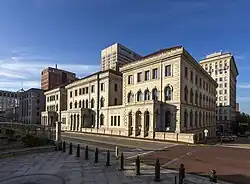
The court is based at the Lewis F. Powell Jr. United States Courthouse in Richmond, Virginia. With 15 authorized judgeships, it is the 4th largest circuit among the 13 United States Courts of Appeals.
Chief judges have administrative responsibilities with respect to their circuits, and preside over any panel on which they serve, unless the circuit justice (the Supreme Court justice responsible for the circuit) is also on the panel. Unlike the Supreme Court, where one justice is specifically nominated to be chief, the office of chief judge rotates among the circuit judges.
To be chief, a judge must have been in active service on the court for at least one year, be under the age of 65, and have not previously served as chief judge. A vacancy is filled by the judge highest in seniority among the group of qualified judges, with seniority determined first by commission date, then by age. The chief judge serves for a term of seven years, or until age 70, whichever occurs first. If no judge qualifies to be chief, the youngest judge over the age of 65 who has served on the court for at least one year shall act as chief until another judge qualifies. If no judge has served on the court for more than a year, the most senior judge shall act as chief. Judges can forfeit or resign their chief judgeship or acting chief judgeship while retaining their active status as a circuit judge.[6]
When the office was created in 1948, the chief judge was the longest-serving judge who had not elected to retire, on what has since 1958 been known as senior status, or declined to serve as chief judge. After August 6, 1959, judges could not become or remain chief after turning 70 years old. The current rules have been in operation since October 1, 1982.[7]
Succession of seats
The court has fifteen seats for active judges, numbered in the order in which they were initially filled. Judges who assume senior status enter a kind of retirement in which they remain on the bench but vacate their seats, thus allowing the U.S. President to appoint new judges to fill their seats.
Seat 1
Established on December 10, 1869 by the Judiciary Act of 1869 as a circuit judgeship for the Fourth Circuit
Reassigned on June 16, 1891 to the United States Circuit Court of Appeals for the Fourth Circuit by the Judiciary Act of 1891
Bond
MD
1891–1893
Simonton
SC
1893–1904
Pritchard
NC
1904–1921
Waddill, Jr.
VA
1921–1931
Soper
MD
1932–1955
Sobeloff
MD
1956–1970
Russell
SC
1971–1998
Traxler, Jr.
SC
1998–2018
Quattlebaum, Jr.
SC
2018–present
Seat 2
Established on June 16, 1891 by the Judiciary Act of 1891
Goff, Jr.
WV
1892–1913
Woods
SC
1913–1925
Parker
NC
1925–1958
Boreman
WV
1959–1971
Field, Jr.
WV
1971–1976
Hall
WV
1976–1998
King
WV
1998–present
Seat 3
Established on September 14, 1922 by 42 Stat. 837
Rose
MD
1922–1927
Northcott
WV
1927–1939
Dobie
VA
1940–1956
Haynsworth
SC
1957–1981
Chapman
SC
1981–1991
Williams
SC
1992–2009
Floyd
SC
2011–2021
Benjamin
SC
2023–present
Seat 4
Established on May 19, 1961 by 75 Stat. 80
Bryan
VA
1961–1972
Widener, Jr.
VA
1972–2007
Keenan
VA
2010–2021
Heytens
VA
2021–present
Seat 5
Established on May 19, 1961 by 75 Stat. 80
Bell
NC
1961–1967
Butzner, Jr.
VA
1967–1982
Wilkinson III
VA
1984–present
Seat 6
Established on March 18, 1966 by 80 Stat. 75
Winter
MD
1966–1990
Niemeyer
MD
1990–present
Seat 7
Established on March 18, 1966 by 80 Stat. 75
Craven, Jr.
NC
1966–1977
Phillips, Jr.
NC
1978–1994
Wynn
NC
2010–present
Seat 8
Established on October 20, 1978 by 92 Stat. 1629
Murnaghan, Jr.
MD
1979–2000
Davis
MD
2009–2014
Harris
MD
2014–present
Seat 9
Established on October 20, 1978 by 92 Stat. 1629
Sprouse
WV
1979–1992
Michael
WV
1993–2011
Thacker
WV
2012–present
Seat 10
Established on October 20, 1978 by 92 Stat. 1629
Ervin III
NC
1980–1999
Duncan
NC
2003–2019
Rushing
NC
2019–present
Seat 11
Established on July 10, 1984 by 98 Stat. 333
Sneeden
NC
1984–1986
Wilkins
SC
1986–2007
Diaz
NC
2010–present
Seat 12
Established on December 1, 1990 by 104 Stat. 5089
Hamilton
SC
1991–1999
Shedd
SC
2002–2018
Richardson
SC
2018–present
Seat 13
Established on December 1, 1990 by 104 Stat. 5089
Luttig
VA
1991–2006
Agee
VA
2008–present
Seat 14
Established on December 1, 1990 by 104 Stat. 5089
Motz
MD
1994–2022
Berner
MD
2024–present
Seat 15
Established on December 1, 1990 by 104 Stat. 5089
Gregory
VA
2000–present
Practice in the 4th Circuit
From 2000 to 2008, the Court had the highest rate of non-publication (92%) on the Federal Circuit.[8]
The Chief Justice is always assigned to the Fourth Circuit as the circuit justice, due to Richmond's close proximity to Washington, D.C.[b]
The Fourth Circuit is considered an extremely collegial court. By tradition, the judges of the Fourth Circuit come down from the bench following each oral argument to greet the lawyers.[9][10]
Case law
Bliley v. West, 42 F.2d 101 (1930)
United States v. Snider, 502 F.2d 645 (1972)
See also
Judicial appointment history for the Fourth Circuit
List of current United States circuit judges
Same-sex marriage in the Fourth Circuit
Notes
^Recess appointment by Bill Clinton on December 27, 2000, re-nominated by George W. Bush on May 9, 2001 and confirmed by the United States Senate on July 20, 2001.
^Under the original Judiciary Act of 1789 and subsequent acts, the justices of the Supreme Court of the United States in Washington, D.C. had the responsibility of "riding circuit" and personally hearing both appeals and trials in the circuit courts, in addition to their caseload back in the capital. This duty was reasonable when the United States consisted of the original Thirteen Colonies along the East Coast of the United States, but became increasingly onerous and impractical with the country's rapid westward expansion during the 19th century, and was repealed by Congress with the enacting of the Judiciary Act of 1891. The U.S. Supreme Court justices still retain vestiges of the days of riding circuit; each justice is designated to hear certain interlocutory appeals from specific circuits and can unilaterally decide them or refer them to the entire court. The court's customary summer recess originated as the time during which the justices would leave Washington and ride circuit (since dirt roads were more passable in the summer).
^"Fourth Circuit Judges". Official website of the United States Court of Appeals for the Fourth Circuit. Retrieved March 19, 2024.
^Bond was appointed as a circuit judge for the Fourth Circuit in 1870 by Ulysses S. Grant. The Judiciary Act of 1891 reassigned his seat to what is now the U.S. Court of Appeals for the Fourth Circuit.
^Knapp did not have a permanent seat on this court. Instead, he was appointed to the ill-fated United States Commerce Court in 1910 by William Howard Taft. Aside from their duties on the Commerce Court, the judges of the Commerce Court also acted as at-large appellate judges, able to be assigned by the Chief Justice of the United States to whichever circuit most needed help. Knapp was assigned to the Second Circuit upon his commission and then to the Fourth Circuit in 1916.
^Aaron S. Bayer (August 24, 2009), Unpublished Appellate Opinions Are Still Commonplace, The National Law Journal
^Roberts, John G. (2006). "What Makes the D.C. Circuit Different?: A Historical View". Virginia Law Review. 92 (3): 375–389. ISSN0042-6601. JSTOR4144947.
American Samoa does not have a district court or federal territorial court; federal matters there go to the District of Columbia, Hawaii, or its own Supreme Court.