Jack Kilby
Jack Kilby | |
|---|---|
.png) Kilby, early 1960s | |
| Born | Jack St. Clair Kilby November 8, 1923 |
| Died | June 20, 2005 (aged 81) Dallas, Texas, US |
| Education | Great Bend High School |
| Alma mater | |
| Known for | Invention of the integrated circuit |
| Spouse |
Barbara Annegers (m. 1948) |
| Children | 2 |
| Awards |
|
| Scientific career | |
| Fields | Microelectronics |
| Institutions | Texas Instruments (1958–1983) |
Jack St. Clair Kilby (November 8, 1923 – June 20, 2005) was an American electronics engineer who took part, along with Robert Noyce of Fairchild Semiconductor, in the realization of the first integrated circuit while working at Texas Instruments in 1958.[1]: 22 For this invention, Kilby shared the 2000 Nobel Prize in Physics.[2]
Kilby was also a co-inventor of the handheld calculator and the thermal printer, for which he had the patents. He also had patents for seven other inventions.[3]
Early life and education
Jack St. Clair Kilby was born on November 8, 1923, in Jefferson City, Missouri. His father ran a small electric company that served customers in rural western Kansas.
Kilby grew up and attended school in Great Bend, Kansas, graduating from Great Bend High School. Today, road signs at the entrances to the town commemorate his time there, and the Commons Area at Great Bend High School has been named The Jack Kilby Commons Area.
Kilby received his B.S. and M.S. degrees, both in electrical engineering, from the University of Illinois in 1947 and the University of Wisconsin in 1950, respectively.
Invention of the integrated circuit
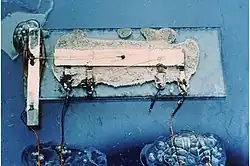
Kilby was vital to the invention of the integrated circuit. In mid-1958, as a newly employed engineer at Texas Instruments (TI), he did not yet have the right to a summer vacation. Kilby spent the summer working on the problem in circuit design that was commonly called the "tyranny of numbers," and he finally came to the conclusion that the manufacturing of circuit components en masse in a single piece of semiconductor material could provide a solution. On September 12, he presented his findings to company's management, which included Mark Shepherd. He showed them a piece of germanium with an oscilloscope attached, pressed a switch, and the oscilloscope showed a continuous sine wave, proving that his integrated circuit worked, and thus that he had solved the problem.[4] U.S. Patent 3,138,743 for "Miniaturized electronic circuits," the first integrated circuit, was filed on February 6, 1959.[5] It was notable for having different components (transistors, diodes, resistors, capacitors, etc.) on one single substrate.[1]: 22 Along with Robert Noyce (who independently made a similar circuit a few months later), Kilby is generally credited as co-inventor of the integrated circuit.
Later career
Kilby went on to pioneer military, industrial, and commercial applications of microchip technology. He headed teams that created the first military system and the first computer incorporating integrated circuits. He invented the handheld calculator (along with Jerry Merryman and James Van Tassel[6]).
In 1970, Kilby took a leave of absence from TI to work as an independent inventor. He explored, among other subjects, the use of silicon technology for generating electrical power from sunlight. From 1978 to 1984, he held the position of Distinguished Professor of Electrical Engineering at Texas A&M University.
Kilby retired from Texas Instruments in 1983.
Family
In 1948, Kilby married Barbara Annegers. They had two daughters, Ann and Janet.[7]
Death and legacy
Kilby died of cancer on June 20, 2005, in Dallas, Texas, at the age of 81.[8]
On December 14, 2005, Texas Instruments created the Historic TI Archives. The Jack Kilby family donated his personal manuscripts and his personal photograph collection to Southern Methodist University (SMU). The collection will be cataloged and stored at DeGolyer Library, SMU.
In 2008, the SMU School of Engineering, with the DeGolyer Library and the Library of Congress, hosted a year-long celebration of the 50th anniversary of the birth of the digital age with Kilby's Nobel Prize-winning invention of the integrated circuit. Symposia and exhibits examined the many ways in which technology and engineers shaped the modern world. Kilby held an honorary doctorate of science from SMU and was a longtime associate of SMU through the Kilby Foundation.
Recognition
Awards
| Year | Organization | Award | Citation | Ref. |
|---|---|---|---|---|
| 1966 |  Franklin Institute Franklin Institute
|
Stuart Ballantine Medal[a] | "For the development of monolithic integrated circuits (microchips)." | [9] |
| 1966 | IEEE
|
IEEE David Sarnoff Award | "For his outstanding creative contribution in the field of monolithic integrated circuits, for his key inventions and for his team leadership in the application of integrated circuits to large scale systems." | [10] |
| 1978 | IEEE
|
IEEE Cledo Brunetti Award[a] | "For contributions to miniaturization through inventions and the development of integrated circuits." | [11] |
| 1982 | ASME
|
Holley Medal | [12] | |
| 1986 | IEEE
|
IEEE Medal of Honor | "For fundamental contributions to semiconductor integrated circuit technology." | [13] |
| 1989 | ASME
|
Holley Medal[b] | [12] | |
| 1989 | National Academy of Engineering
|
Charles Stark Draper Prize[a] | "For their independent development of the monolithic integrated circuit." | [14] |
| 1993 | IEEE Computer Society
|
Computer Pioneer Award | "For co-inventing the integrated circuit." | [15] |
| 1993 |  Inamori Foundation Inamori Foundation
|
Kyoto Prize in Advanced Technology | "Creation of the Concept of the Monolithic Semiconductor Integrated Circuit and Its Demonstration." | [16] |
| 1999 | Western Society of Engineers
|
Washington Award | "For his distinguished electronics career, including the invention of the monolithic integrated circuit which was the foundation for modern electrics." | [17] |
| 2000 |  Royal Swedish Academy of Sciences Royal Swedish Academy of Sciences
|
Nobel Prize in Physics[c] | "For his part in the invention of the integrated circuit." | [2] |
| 2000 | University of Pennsylvania
|
Harold Pender Award | "For his contribution to the invention of the integrated circuit, or microchip." | [18] |
Memberships
| Year | Organization | Type | Ref. |
|---|---|---|---|
| 1967 | National Academy of Engineering
|
Member | [19] |
| 2001 | American Philosophical Society
|
Member | [20] |
National awards
| Year | Head of state | Award | Citation | Ref. |
|---|---|---|---|---|
| 1969 | Richard Nixon
|
National Medal of Science | "For original conceptions and valuable contributions in the production and application of integrated circuits." | [21] |
| 1990 | George H. W. Bush
|
National Medal of Technology and Innovation | "For original conceptions and valuable contributions in the production and application of integrated circuits." | [22] |
Honorary degrees
| Year | University | Degree | Ref. |
|---|---|---|---|
| 1988 | University of Illinois Urbana-Champaign
|
[23] | |
| 1990 | University of Wisconsin–Madison
|
Doctor of Science | [24] |
| 1995 | Southern Methodist University
|
Doctor of Science | [25] |
| 1996 | Yale University
|
Doctor of Science | [26] |
Commemoration
The Kilby Award Foundation was founded in 1980 in his honor, and the IEEE Jack S. Kilby Signal Processing Medal was created in 1995.
The Kilby Labs, TI's research laboratory for silicon manufacturing and integrated circuit design, is named after him.
The Jack Kilby Computer Centre at the Merchiston Campus of Edinburgh Napier University in Edinburgh is also named in his honor.[27]
A statue of Jack Kilby stands in Texas Instruments Plaza on the campus of The University of Texas at Dallas.[28]
Barton Community College in Great Bend, Kansas, holds an annual Jack Kilby STEM Day. [29]
See also
- Geoffrey Dummer
Notes
References
- ^ a b Harper, Charles A., ed. (2004). Electronic materials and processes handbook. McGraw-Hill handbooks (3 ed.). McGraw-Hill. ISBN 9780071402149.
- ^ a b "Nobel Prize in Physics 2000". Nobel Foundation. Archived from the original on October 21, 2008. Retrieved October 9, 2008.
- ^ "The Chip that Jack Built". IT Invention. Retrieved May 27, 2014.
- ^ Das, Saswato R. (September 19, 2008). "Opinion: The chip that changed the world". The New York Times.
- ^ US patent 3138743, Jack S Kilby, "Miniaturized electronic circuits", issued June 23, 1964, assigned to Texas Instruments Inc
- ^ Stengle, Jamie (March 7, 2019). "Jerry Merryman, co-inventor of handheld electronic calculator, dies at 86". The Washington Post. Retrieved March 8, 2019.
- ^ "Jack S. Kilby". American Institute of Physics. Archived from the original on June 13, 2025. Retrieved February 15, 2026.
- ^ John Markoff (June 22, 2005). "Jack S. Kilby, an Inventor of the Microchip, Is Dead at 81". New York Times. Retrieved January 9, 2022.
- ^ "Jack S. Kilby". Franklin Institute. Archived from the original on March 29, 2025. Retrieved February 15, 2026.
- ^ "IEEE David Sarnoff Award Recipients" (PDF). IEEE. Archived from the original (PDF) on June 19, 2010. Retrieved December 6, 2011.
- ^ "IEEE Cledo Brunetti Award Recipients" (PDF). IEEE. Archived from the original (PDF) on August 4, 2018. Retrieved December 6, 2019.
- ^ a b "Holley Medal". www.asme.org. Archived from the original on August 14, 2025. Retrieved December 6, 2011.
- ^ "Jack St. Clair Kilby". Institute of Electrical and Electronics Engineers. Archived from the original on December 1, 2023. Retrieved May 13, 2024.
- ^ "1989 Winners: Jack S. Kilby and Robert N. Noyce". draperprize.org. Archived from the original on April 10, 2016. Retrieved February 13, 2026.
- ^ "Jack S. Kilby". www.computer.org. Archived from the original on September 16, 2025. Retrieved February 15, 2026.
- ^ "Jack St. Clair Kilby". www.kyotoprize.org. Archived from the original on February 5, 2025. Retrieved October 15, 2016.
- ^ "Recipients". www.washingtonaward.com. Archived from the original on July 15, 2025. Retrieved November 18, 2025.
- ^ "The Harold Pender Award Lecture". University of Pennsylvania. Archived from the original on August 15, 2025. Retrieved September 19, 2024.
- ^ "Mr. Jack S. Kilby". www.nae.edu. Archived from the original on August 6, 2024. Retrieved December 6, 2011.
- ^ "APS Member History". search.amphilsoc.org. Archived from the original on November 27, 2024. Retrieved October 19, 2021.
- ^ "Jack St. Clair Kilby". nationalmedals.org. Archived from the original on September 15, 2025. Retrieved February 15, 2026.
- ^ "Jack St. Clair Kilby". nationalmedals.org. Archived from the original on November 10, 2025. Retrieved February 15, 2026.
- ^ "Jack S. Kilby". grainger.illinois.edu. Archived from the original on September 9, 2025. Retrieved February 15, 2026.
- ^ "Honorary Degree Recipients". secfac.wisc.edu. Archived from the original on November 16, 2025. Retrieved February 15, 2025.
- ^ "Jack St. Clair Kilby". s3.smu.edu. Archived from the original on July 19, 2024. Retrieved February 15, 2026.
- ^ "Honorary Degrees Since 1702". Yale University. Retrieved February 15, 2026.
{{cite web}}: CS1 maint: url-status (link) - ^ "School of Computing – Facilities & Resources". Edinburgh Napier University. Archived from the original on June 25, 2013. Retrieved July 24, 2012.
- ^ "What's the Story? The TI Plaza Statue".
- ^ https://bartonccc.edu/jack-kilby-stem-day.
{{cite web}}: Missing or empty|title=(help)
References bibliography
- Berlin, Leslie The man behind the microchip: Robert Noyce and the invention of Silicon Valley Publisher Oxford University Press US, 2005 ISBN 0-19-516343-5
- Lécuyer, Christophe. Making Silicon Valley: Innovation and the Growth of High Tech, 1930-1970 Published by MIT Press, 2006.ISBN 0262122812
- Nobel lectures, World Scientific Publishing Co., Singapore, 2000.
External links
 Media related to Jack Kilby at Wikimedia Commons

- "Jack St. Clair Kilby: A Man of Few Words", biography by Ed Millis.
- "From concept to cosmos: How Jack Kilby's integrated circuit transformed the electronics industry" Archived May 22, 2021, at the Wayback Machine, biography by Texas Instruments.
- "Jack Kilby, Touching Lives on Micro and Macro Scales" by T.R. Reid, The Washington Post (June 2005).
- Jack S. Kilby Patents
- "Tribute to Jack Kilby", Dream 2047, November 2005
Laureates of the Nobel Prize in Physics | ||
|---|---|---|
| 1901–1925 |
|  |
| 1926–1950 |
| |
| 1951–1975 |
| |
| 1976–2000 |
| |
| 2001– present |
| |