Not to be confused with
Nitrification, Nitrosation, or Nitriding.
In organic chemistry, nitration is a general class of chemical processes for the introduction of a nitro group (−NO2) into an organic compound. The term also is applied incorrectly to the different process of forming nitrate esters (−ONO2) between alcohols and nitric acid (as occurs in the synthesis of nitroglycerin). The difference between the resulting molecular structures of nitro compounds and nitrates (NO−3) is that the nitrogen atom in nitro compounds is directly bonded to a non-oxygen atom (typically carbon or another nitrogen atom), whereas in nitrate esters (also called organic nitrates), the nitrogen is bonded to an oxygen atom that in turn usually is bonded to a carbon atom (nitrito group).
There are many major industrial applications of nitration in the strict sense; the most important by volume are for the production of nitroaromatic compounds such as nitrobenzene. The technology is long-standing and mature.[1][2][3]

Nitration reactions are notably used for the production of explosives, for example the conversion of guanidine to nitroguanidine and the conversion of toluene to trinitrotoluene (TNT). Nitrations are, however, of wide importance as virtually all aromatic amines (anilines) are produced from nitro precursors. Millions of tons of nitroaromatics are produced annually.[2]
Aromatic nitration
Typical nitrations of aromatic compounds rely on a reagent called "mixed acid", a mixture of concentrated nitric acid and sulfuric acids.[4][2] This mixture produces the nitronium ion (NO2+), which is the active species in aromatic nitration. This active ingredient, which can be isolated in the case of nitronium tetrafluoroborate,[5] also effects nitration without the need for the mixed acid. In mixed-acid syntheses sulfuric acid is not consumed and hence acts as a catalyst as well as an absorbent for water. In the case of nitration of benzene, the reaction is conducted at a warm temperature, not exceeding 50 °C.[6] The process is one example of electrophilic aromatic substitution, which involves the attack by the electron-rich benzene ring:
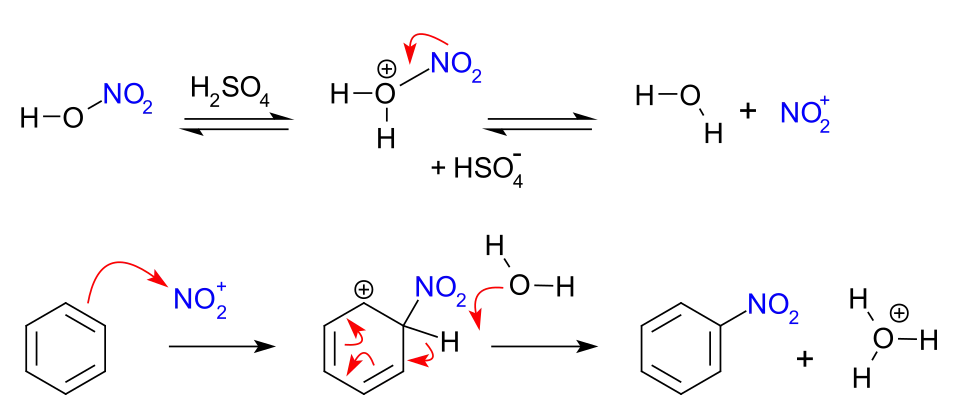
Alternative mechanisms have also been proposed, including one involving single electron transfer (SET).[7][8]
Scope
Selectivity can be a challenge. Often alternative products act as contaminants or are simply wasted. Considerable attention thus is paid to optimization of the reaction conditions. For example, the mixed acid can be derived from phosphoric or perchloric acids in place of sulfuric acid.[2]
Regioselectivity is strongly affected by substituents on aromatic rings (see electrophilic aromatic substitution). For example, nitration of nitrobenzene gives all three isomers of dinitrobenzenes in a ratio of 93:6:1 (respectively meta, ortho, para).[9] Electron-withdrawing groups such as other nitro are deactivating. Nitration is accelerated by the presence of activating groups such as amino, hydroxy and methyl groups also amides and ethers resulting in para and ortho isomers. In addition to regioselectivity, the degree of nitration is of interest. Fluorenone, for example, can be selectively trinitrated[10] or tetranitrated.[11]
The direct nitration of aniline with nitric acid and sulfuric acid, according to one source,[12] results in a 50/50 mixture of para- and meta-nitroaniline isomers. In this reaction the fast-reacting and activating aniline (ArNH2) exists in equilibrium with the more abundant but less reactive (deactivated) anilinium ion (ArNH3+), which may explain this reaction product distribution. According to another source,[13] a more controlled nitration of aniline starts with the formation of acetanilide by reaction with acetic anhydride followed by the actual nitration. Because the amide is a regular activating group the products formed are the para and ortho isomers. Heating the reaction mixture is sufficient to hydrolyze the amide back to the nitrated aniline.
Alternatives to nitric acid
Mixture of nitric and acetic acids or nitric acid and acetic anhydride is commercially important in the production of RDX, as amines are destructed by sulfuric acid. Acetyl nitrate had also been used as a nitration agent.[14][15]
In the Wolffenstein–Böters reaction, benzene reacts with nitric acid and mercury(II) nitrate to give picric acid.
In the second half of the 20th century, new reagents were developed for laboratory usage, mainly N-nitro heterocyclic compounds.[16]
Ipso nitration
With aryl chlorides, triflates and nonaflates, ipso nitration may also take place.[17] The phrase ipso nitration was first used by Perrin and Skinner in 1971, in an investigation into chloroanisole nitration.[18] In one protocol, 4-chloro-n-butylbenzene is reacted with sodium nitrite in t-butanol in the presence of 0.5 mol% Pd2(dba)3, a biarylphosphine ligand and a phase-transfer catalyst to provide 4-nitro-n-butylbenzene.[19]
See also
- Menke nitration
- Zincke nitration
- Reactive nitrogen species
References
- ^ *Schofield, K. (1971). Nitration and Aromatic Reactivity. Cambridge: Cambridge University Press.
- ^ a b c d Gerald Booth (2007). "Nitro Compounds, Aromatic". Ullmann's Encyclopedia of Industrial Chemistry. Weinheim: Wiley-VCH. doi:10.1002/14356007.a17_411. ISBN 978-3527306732.
- ^ Olahfirst1=G.A.; Malhotra, R.; Narang, S.C. (1989). Nitration: Methods and Mechanisms. NY: VCH. ISBN 978-0-471-18695-3.
{{cite book}}: CS1 maint: numeric names: authors list (link)
- ^ John McMurry Organic Chemistry 2nd Ed.
- ^ George A. Olah and Stephen J. Kuhn. "Benzonitrile, 2-methyl-3,5-dinitro-". Organic Syntheses; Collected Volumes, vol. 5, p. 480.
- ^ "Nitration of benzene and methylbenzene".
- ^ Esteves, P. M.; Carneiro, J. W. M.; Cardoso, S. P.; Barbosa, A. G. H.; Laali, K. K.; Rasul, G.; Prakash, G. K. S.; e Olah, G. A. (2003). "Unified Mechanism Concept of Electrophilic Aromatic Nitration Revisited: Convergence of Computational Results and Experimental Data". J. Am. Chem. Soc. 125 (16): 4836–49. doi:10.1021/ja021307w. PMID 12696903.
- ^ Queiroz, J. F.; Carneiro, J. W. M.; Sabino A. A.; Sparapan, R.; Eberlin, M. N.; Esteves, P. M. (2006). "Electrophilic Aromatic Nitration: Understanding Its Mechanism and Substituent Effects". J. Org. Chem. 71 (16): 6192–203. doi:10.1021/jo0609475. PMID 16872205.
- ^ Smith, Michael B.; March, Jerry (2007), Advanced Organic Chemistry: Reactions, Mechanisms, and Structure (6th ed.), New York: Wiley-Interscience, p. 665, ISBN 978-0-471-72091-1
- ^ E. O. Woolfolk and Milton Orchin. "2,4,7-Trinitrofluorenone". Organic Syntheses; Collected Volumes, vol. 3, p. 837.
- ^ Melvin S. Newman and H. Boden. "2,4,5,7-Tetranitrofluorenone". Organic Syntheses; Collected Volumes, vol. 5, p. 1029.
- ^ Web resource: warren-wilson.edu Archived 2012-03-20 at the Wayback Machine
- ^ Mechanism and synthesis Peter Taylor, Royal Society of Chemistry (Great Britain), Open University
- ^ Louw, Robert "Acetyl nitrate" e-EROS Encyclopedia of Reagents for Organic Synthesis 2001, 1-2. doi:10.1002/047084289X.ra032
- ^ Smith, Keith; Musson, Adam; Deboos, Gareth A. (1998). "A Novel Method for the Nitration of Simple Aromatic Compounds". The Journal of Organic Chemistry. 63 (23): 8448–8454. doi:10.1021/jo981557o.
- ^ Yang, Tao; Li, Xiaoqian; Deng, Shuang; Qi, Xiaotian; Cong, Hengjiang; Cheng, Hong-Gang; Shi, Liangwei; Zhou, Qianghui; Zhuang, Lin (2022-09-26). "From N–H Nitration to Controllable Aromatic Mononitration and Dinitration─The Discovery of a Versatile and Powerful N -Nitropyrazole Nitrating Reagent". JACS Au. 2 (9): 2152–2161. doi:10.1021/jacsau.2c00413. ISSN 2691-3704. PMC 9516713. PMID 36186553.
- ^ Prakash, G.; Mathew, T. (2010). "Ipso-Nitration of Arenes". Angewandte Chemie International Edition in English. 49 (10): 1726–1728. doi:10.1002/anie.200906940. PMID 20146295.
- ^ Perrin, C. L.; Skinner, G. A. (1971). "Directive effects in electrophilic aromatic substitution ("ipso factors"). Nitration of haloanisoles". Journal of the American Chemical Society. 93 (14): 3389. Bibcode:1971JAChS..93.3389P. doi:10.1021/ja00743a015.
- ^ Fors, B.; Buchwald, S. (2009). "Pd-Catalyzed Conversion of Aryl Chlorides, Triflates, and Nonaflates to Nitroaromatics". Journal of the American Chemical Society. 131 (36): 12898–12899. Bibcode:2009JAChS.13112898F. doi:10.1021/ja905768k. PMC 2773681. PMID 19737014.
Topics in organic reactions |
|---|
- Addition reaction
- Elimination reaction
- Polymerization
- Reagents
- Rearrangement reaction
- Redox reaction
- Regioselectivity
- Stereoselectivity
- Stereospecificity
- Substitution reaction
|
- A value
- Alpha effect
- Annulene
- Anomeric effect
- Antiaromaticity
- Aromatic ring current
- Aromaticity
- Baird's rule
- Baker–Nathan effect
- Baldwin's rules
- Bema Hapothle
- Beta-silicon effect
- Bicycloaromaticity
- Bredt's rule
- Bürgi–Dunitz angle
- Catalytic resonance theory
- Charge remote fragmentation
- Charge-transfer complex
- Clar's rule
- Conformational isomerism
- Conjugated system
- Conrotatory and disrotatory
- Curtin–Hammett principle
- Dynamic binding (chemistry)
- Edwards equation
- Effective molarity
- Electromeric effect
- Electron-rich
- Electron-withdrawing group
- Electronic effect
- Electrophile
- Evelyn effect
- Flippin–Lodge angle
- Free-energy relationship
- Grunwald–Winstein equation
- Hammett acidity function
- Hammett equation
- George S. Hammond
- Hammond's postulate
- Homoaromaticity
- Hückel's rule
- Hyperconjugation
- Inductive effect
- Kinetic isotope effect
- LFER solvent coefficients (data page)
- Marcus theory
- Markovnikov's rule
- Möbius aromaticity
- Möbius–Hückel concept
- More O'Ferrall–Jencks plot
- Negative hyperconjugation
- Neighbouring group participation
- 2-Norbornyl cation
- Nucleophile
- Kennedy J. P. Orton
- Passive binding
- Phosphaethynolate
- Polar effect
- Polyfluorene
- Ring strain
- Σ-aromaticity
- Spherical aromaticity
- Spiroaromaticity
- Steric effects
- Superaromaticity
- Swain–Lupton equation
- Taft equation
- Thorpe–Ingold effect
- Vinylogy
- Walsh diagram
- Woodward–Hoffmann rules
- Woodward's rules
- Y-aromaticity
- Yukawa–Tsuno equation
- Zaitsev's rule
- Σ-bishomoaromaticity
List of organic reactions |
|---|
Carbon-carbon
bond forming
reactions | | Homologation reactions |
- Arndt–Eistert reaction
- Hooker reaction
- Kiliani–Fischer synthesis
- Kowalski ester homologation
- Methoxymethylenetriphenylphosphorane
- Seyferth–Gilbert homologation
- Wittig reaction
|
|---|
| Olefination reactions |
- Bamford–Stevens reaction
- Barton–Kellogg reaction
- Boord olefin synthesis
- Chugaev elimination
- Cope reaction
- Corey–Winter olefin synthesis
- Dehydrohalogenation
- Elimination reaction
- Grieco elimination
- Hofmann elimination
- Horner–Wadsworth–Emmons reaction
- Hydrazone iodination
- Julia olefination
- Julia–Kocienski olefination
- Kauffmann olefination
- McMurry reaction
- Peterson olefination
- Ramberg–Bäcklund reaction
- Shapiro reaction
- Takai olefination
- Wittig reaction
|
|---|
|
|---|
Carbon-heteroatom
bond forming
reactions |
- Azo coupling
- Bartoli indole synthesis
- Boudouard reaction
- Cadogan–Sundberg indole synthesis
- Diazonium compound
- Esterification
- Grignard reagent
- Haloform reaction
- Hegedus indole synthesis
- Hurd–Mori 1,2,3-thiadiazole synthesis
- Kharasch–Sosnovsky reaction
- Knorr pyrrole synthesis
- Leimgruber–Batcho indole synthesis
- Mukaiyama hydration
- Nenitzescu indole synthesis
- Oxymercuration reaction
- Reed reaction
- Schotten–Baumann reaction
- Ullmann condensation
- Williamson ether synthesis
- Yamaguchi esterification
|
|---|
Degradation
reactions |
- Barbier–Wieland degradation
- Bergmann degradation
- Edman degradation
- Emde degradation
- Gallagher–Hollander degradation
- Hofmann rearrangement
- Hooker reaction
- Isosaccharinic acid
- Marker degradation
- Ruff degradation
- Strecker degradation
- Von Braun amide degradation
- Weerman degradation
- Wohl degradation
|
|---|
Organic redox
reactions |
- Acyloin condensation
- Adkins–Peterson reaction
- Akabori amino-acid reaction
- Alcohol oxidation
- Algar–Flynn–Oyamada reaction
- Amide reduction
- Andrussow process
- Angeli–Rimini reaction
- Aromatization
- Autoxidation
- Baeyer–Villiger oxidation
- Barton–McCombie deoxygenation
- Bechamp reduction
- Benkeser reaction
- Bergmann degradation
- Birch reduction
- Bohn–Schmidt reaction
- Bosch reaction
- Bouveault–Blanc reduction
- Boyland–Sims oxidation
- Cannizzaro reaction
- Carbonyl reduction
- Clemmensen reduction
- Collins oxidation
- Corey–Itsuno reduction
- Corey–Kim oxidation
- Corey–Winter olefin synthesis
- Criegee oxidation
- Dakin oxidation
- Davis oxidation
- Deoxygenation
- Dess–Martin oxidation
- DNA oxidation
- Elbs persulfate oxidation
- Emde degradation
- Eschweiler–Clarke reaction
- Étard reaction
- Fischer–Tropsch process
- Fleming–Tamao oxidation
- Fukuyama reduction
- Ganem oxidation
- Glycol cleavage
- Griesbaum coozonolysis
- Grundmann aldehyde synthesis
- Haloform reaction
- Hydrogenation
- Hydrogenolysis
- Hydroxylation
- Jones oxidation
- Kiliani–Fischer synthesis
- Kolbe electrolysis
- Kornblum oxidation
- Kornblum–DeLaMare rearrangement
- Leuckart reaction
- Ley oxidation
- Lindgren oxidation
- Lipid peroxidation
- Lombardo methylenation
- Luche reduction
- Markó–Lam deoxygenation
- McFadyen–Stevens reaction
- Meerwein–Ponndorf–Verley reduction
- Methionine sulfoxide
- Miyaura borylation
- Mozingo reduction
- Noyori asymmetric hydrogenation
- Omega oxidation
- Oppenauer oxidation
- Oxygen rebound mechanism
- Ozonolysis
- Parikh–Doering oxidation
- Pinnick oxidation
- Prévost reaction
- Reduction of nitro compounds
- Reductive amination
- Riley oxidation
- Rosenmund reduction
- Rubottom oxidation
- Sabatier reaction
- Sarett oxidation
- Selenoxide elimination
- Shapiro reaction
- Sharpless asymmetric dihydroxylation
- Epoxidation of allylic alcohols
- Sharpless epoxidation
- Sharpless oxyamination
- Stahl oxidation
- Staudinger reaction
- Stephen aldehyde synthesis
- Swern oxidation
- Transfer hydrogenation
- Wacker process
- Wharton reaction
- Whiting reaction
- Wohl–Aue reaction
- Wolff–Kishner reduction
- Wolffenstein–Böters reaction
- Zinin reaction
|
|---|
Rearrangement
reactions |
- 1,2-rearrangement
- 1,2-Wittig rearrangement
- 2,3-sigmatropic rearrangement
- 2,3-Wittig rearrangement
- Achmatowicz reaction
- Alkyne zipper reaction
- Allen–Millar–Trippett rearrangement
- Allylic rearrangement
- Alpha-ketol rearrangement
- Amadori rearrangement
- Arndt–Eistert reaction
- Aza-Cope rearrangement
- Baker–Venkataraman rearrangement
- Bamberger rearrangement
- Banert cascade
- Beckmann rearrangement
- Benzilic acid rearrangement
- Bergman cyclization
- Bergmann degradation
- Boekelheide reaction
- Brook rearrangement
- Buchner ring expansion
- Carroll rearrangement
- Chan rearrangement
- Claisen rearrangement
- Cope rearrangement
- Corey–Fuchs reaction
- Cornforth rearrangement
- Criegee rearrangement
- Curtius rearrangement
- Demjanov rearrangement
- Di-π-methane rearrangement
- Dimroth rearrangement
- Divinylcyclopropane-cycloheptadiene rearrangement
- Dowd–Beckwith ring-expansion reaction
- Electrocyclic reaction
- Ene reaction
- Enyne metathesis
- Favorskii reaction
- Favorskii rearrangement
- Ferrier carbocyclization
- Ferrier rearrangement
- Fischer–Hepp rearrangement
- Fries rearrangement
- Fritsch–Buttenberg–Wiechell rearrangement
- Gabriel–Colman rearrangement
- Group transfer reaction
- Halogen dance rearrangement
- Hayashi rearrangement
- Hofmann rearrangement
- Hofmann–Martius rearrangement
- Ireland–Claisen rearrangement
- Jacobsen rearrangement
- Kornblum–DeLaMare rearrangement
- Kowalski ester homologation
- Lobry de Bruyn–Van Ekenstein transformation
- Lossen rearrangement
- McFadyen–Stevens reaction
- McLafferty rearrangement
- Meyer–Schuster rearrangement
- Mislow–Evans rearrangement
- Mumm rearrangement
- Myers allene synthesis
- Nazarov cyclization reaction
- Neber rearrangement
- Newman–Kwart rearrangement
- Overman rearrangement
- Oxy-Cope rearrangement
- Pericyclic reaction
- Piancatelli rearrangement
- Pinacol rearrangement
- Pummerer rearrangement
- Ramberg–Bäcklund reaction
- Ring expansion and contraction
- Ring-closing metathesis
- Rupe reaction
- Schmidt reaction
- Semipinacol rearrangement
- Seyferth–Gilbert homologation
- Sigmatropic reaction
- Skattebøl rearrangement
- Smiles rearrangement
- Sommelet–Hauser rearrangement
- Stevens rearrangement
- Stieglitz rearrangement
- Thermal rearrangement of aromatic hydrocarbons
- Tiffeneau–Demjanov rearrangement
- Vinylcyclopropane rearrangement
- Wagner–Meerwein rearrangement
- Wallach rearrangement
- Weerman degradation
- Westphalen–Lettré rearrangement
- Willgerodt rearrangement
- Wolff rearrangement
|
|---|
Ring forming
reactions |
- 1,3-Dipolar cycloaddition
- Annulation
- Azide-alkyne Huisgen cycloaddition
- Baeyer–Emmerling indole synthesis
- Bartoli indole synthesis
- Bergman cyclization
- Biginelli reaction
- Bischler–Möhlau indole synthesis
- Bischler–Napieralski reaction
- Blum–Ittah aziridine synthesis
- Bobbitt reaction
- Bohlmann–Rahtz pyridine synthesis
- Borsche–Drechsel cyclization
- Bucherer carbazole synthesis
- Bucherer–Bergs reaction
- Cadogan–Sundberg indole synthesis
- Camps quinoline synthesis
- Chichibabin pyridine synthesis
- Cook–Heilbron thiazole synthesis
- Cycloaddition
- Darzens reaction
- Davis–Beirut reaction
- De Kimpe aziridine synthesis
- Debus–Radziszewski imidazole synthesis
- Dieckmann condensation
- Diels–Alder reaction
- Feist–Benary synthesis
- Ferrario–Ackermann reaction
- Fiesselmann thiophene synthesis
- Fischer indole synthesis
- Fischer oxazole synthesis
- Friedländer synthesis
- Gewald reaction
- Graham reaction
- Hantzsch pyridine synthesis
- Hegedus indole synthesis
- Hemetsberger indole synthesis
- Hofmann–Löffler reaction
- Hurd–Mori 1,2,3-thiadiazole synthesis
- Iodolactonization
- Isay reaction
- Jacobsen epoxidation
- Johnson–Corey–Chaykovsky reaction
- Knorr pyrrole synthesis
- Knorr quinoline synthesis
- Kröhnke pyridine synthesis
- Kulinkovich reaction
- Larock indole synthesis
- Madelung synthesis
- Nazarov cyclization reaction
- Nenitzescu indole synthesis
- Niementowski quinazoline synthesis
- Niementowski quinoline synthesis
- Paal–Knorr synthesis
- Paternò–Büchi reaction
- Pechmann condensation
- Petrenko-Kritschenko piperidone synthesis
- Pictet–Spengler reaction
- Pomeranz–Fritsch reaction
- Prilezhaev reaction
- Pschorr cyclization
- Reissert indole synthesis
- Ring-closing metathesis
- Robinson annulation
- Sharpless epoxidation
- Simmons–Smith reaction
- Skraup reaction
- Urech hydantoin synthesis
- Van Leusen reaction
- Wenker synthesis
| Cycloaddition |
- 1,3-Dipolar cycloaddition
- 4+4 Photocycloaddition
- (4+3) cycloaddition
- 6+4 Cycloaddition
- Alkyne trimerisation
- Aza-Diels–Alder reaction
- Azide-alkyne Huisgen cycloaddition
- Bradsher cycloaddition
- Cheletropic reaction
- Conia-ene reaction
- Cyclopropanation
- Diazoalkane 1,3-dipolar cycloaddition
- Diels–Alder reaction
- Enone–alkene cycloadditions
- Hexadehydro Diels–Alder reaction
- Intramolecular Diels–Alder cycloaddition
- Inverse electron-demand Diels–Alder reaction
- Ketene cycloaddition
- McCormack reaction
- Metal-centered cycloaddition reactions
- Nitrone-olefin (3+2) cycloaddition
- Oxo-Diels–Alder reaction
- Ozonolysis
- Pauson–Khand reaction
- Povarov reaction
- Prato reaction
- Retro-Diels–Alder reaction
- Staudinger synthesis
- Trimethylenemethane cycloaddition
- Vinylcyclopropane (5+2) cycloaddition
- Wagner-Jauregg reaction
|
|---|
| Heterocycle forming reactions |
- Algar–Flynn–Oyamada reaction
- Allan–Robinson reaction
- Auwers synthesis
- Bamberger triazine synthesis
- Banert cascade
- Barton–Zard reaction
- Bernthsen acridine synthesis
- Bischler–Napieralski reaction
- Bobbitt reaction
- Boger pyridine synthesis
- Borsche–Drechsel cyclization
- Bucherer carbazole synthesis
- Bucherer–Bergs reaction
- Chichibabin pyridine synthesis
- Cook–Heilbron thiazole synthesis
- Diazoalkane 1,3-dipolar cycloaddition
- Einhorn–Brunner reaction
- Erlenmeyer–Plöchl azlactone and amino-acid synthesis
- Feist–Benary synthesis
- Fischer oxazole synthesis
- Gabriel–Colman rearrangement
- Gewald reaction
- Hantzsch ester
- Hantzsch pyridine synthesis
- Herz reaction
- Knorr pyrrole synthesis
- Kröhnke pyridine synthesis
- Lectka enantioselective beta-lactam synthesis
- Lehmstedt–Tanasescu reaction
- Niementowski quinazoline synthesis
- Nitrone-olefin (3+2) cycloaddition
- Paal–Knorr synthesis
- Pellizzari reaction
- Pictet–Spengler reaction
- Pomeranz–Fritsch reaction
- Prilezhaev reaction
- Robinson–Gabriel synthesis
- Stollé synthesis
- Urech hydantoin synthesis
- Wenker synthesis
- Wohl–Aue reaction
|
|---|
|
|---|
|