For a related discussion, see
Price index. For macroeconomic determination of the price level, see
AD–AS model.
The general price level is a hypothetical measure of overall prices for some set of goods and services (the consumer basket), in an economy or monetary union during a given interval (generally one day), normalized relative to some base set. Typically, the general price level is approximated with a daily price index, normally the Daily CPI. The general price level can change more than once per day during hyperinflation.
Theoretical foundation
The classical dichotomy is the assumption that there is a relatively clean distinction between overall increases or decreases in prices and underlying, “nominal” economic variables. Thus, if prices overall increase or decrease, it is assumed that this change can be decomposed as follows:
Given a set  of goods and services, the total value of transactions in at time
  is
is
![{\displaystyle \sum _{c\,\in \,C}(p_{c,t}\cdot q_{c,t})=\sum _{c\,\in \,C}[(P_{t}\cdot p'_{c,t})\cdot q_{c,t}]=P_{t}\cdot \sum _{c\,\in \,C}(p'_{c,t}\cdot q_{c,t})}](./_assets_/eb734a37dd21ce173a46342d1cc64c92/e94c629f798bc59a9bffa9c8c9f193c28f5ea6f9.svg)
where
 represents the quantity of
  at time
  represents the prevailing price of at time
  represents the “real” price of at time
  is the price level at time
The general price level is distinguished from a price index in that the existence of the former depends upon the classical dichotomy, while the latter is simply a computation, and many such will be possible regardless of whether they are meaningful.
Significance
If, indeed, a general price level component could be distinguished, then it would be possible to measure the difference in overall prices between two regions or intervals. For example, the inflation rate could be measured as
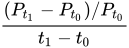
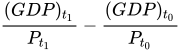
and “real” economic growth or contraction could be distinguished from mere price changes by deflating GDP or some other measure.
Measuring price level
Applicable indices are the consumer price index (CPI), Default Price Deflator, and the Producer Price Index.
Price indices not only affect the rate of inflation, but are also part of real output and productivity.[1]
See also
References
- ^ SAMUELSON, P. A., NORDHAUS, W. D. Ekonomie. 19. vydání. Praha: NS Svoboda, 2013. 715 s. ISBN 978-80-205-0629-0.
Sources
- McCulloch, James Huston (1 January 1982). Money and Inflation: A Monetarist Approach. Academic Press. ISBN 978-0-12-483051-6.
- Mises, Ludwig Heinrich Edler von; Human Action: A Treatise on Economics (1949), Ch. XVII “Indirect Exchange”, §4. “The Determination of the Purchasing Power of Money”.
|
|---|
| Theoretical | |
|---|
| Empirical | |
|---|
| Applied |
- Agriculture
- Business
- Cultural
- Demographic
- Development
- Ecological
- Education
- Engineering
- Environmental
- Evolutionary
- Financial
- Geographic
- Happiness
- Health
- History
- Information
- Infrastructure
- Institutions
- Labour
- Law
- Management
- Non-monetary
- Organization
- Participation
- Personnel
- Planning
- Policy
- Public sector
- Public choice
- Social choice
- Regional
- Regulatory
- Resources
- Rural
- Service
- Transport
- Urban
- Welfare
|
|---|
Schools
(history)
| |
|---|
| |
|---|
| Lists |
- Glossary
- Economists
- Publications (journals)
- Schools
|
|---|
- Category
- Index
- Lists
- Outline
- Publications
- Business portal
|
Economic history of the United States and Commonwealth of Nations countries |
|---|
Commercial revolution
(1000–1760) |
- Great Bullion Famine (c. 1400–c. 1500)
- Great Slump (1430–1490)
- The Great Debasement (1544–1551)
- Financial Revolution (1690–1800)
- Slump of 1706
- Great Frost of 1709
- South Sea bubble (1713–1720)
- Mississippi bubble (1717–1720)
- Economic impact of the Seven Years' War (1754–1763)
|
|---|
1st Industrial Revolution/
Market Revolution
(1760–1870) |
- Industrial Revolution
- Scotland
- United States
- Wales
- Bengal Bubble of 1769 (1769–1784)
- British credit crisis of 1772–1773
- American Revolutionary War inflation (1775–1783)
- Panic of 1785 (1785–1788)
- Copper Panic of 1789/Panic of 1792 (1789–1793)
- Canal Mania (c. 1790–c. 1810)
- Panic of 1796–1797 (1796–1799)
- 1802–1804 recession
- Carolina gold rush (1802–1825)
- Depression of 1807 (1807–1810)
- 1810s Alabama real estate bubble
- 1812 recession
- Post-Napoleonic Depression (1815–1821)
- 1822–23 recession
- Panic of 1825
- Panic of 1826
- 1828–29 recession
- Georgia Gold Rush (1828–c. 1840)
- 1830s Chicago real estate bubble
- 1833–34 recession
- Panic of 1837 (1836–1838 and 1839–1843)
- U.S. state defaults in the 1840s
- Railway Mania (c. 1840–c. 1850)
- Plank Road Boom (1844–c. 1855)
- 1845–46 recession
- Panic of 1847 (1847–1848)
- California gold rush (1848–1855)
- British Columbia gold rushes
- Queen Charlottes Gold Rush, 1851
- Fraser Canyon Gold Rush, 1858
- Rock Creek Gold Rush, 1859
- Similkameen Gold Rush, 1860
- Stikine Gold Rush, 1861
- Cariboo Gold Rush, 1861–1867
- Wild Horse Creek Gold Rush, 1863–1870
- Leechtown Gold Rush, 1864–1865
- Big Bend Gold Rush, c. 1865
- Omineca Gold Rush, 1869
- Victorian gold rush (1851–c. 1870)
- New South Wales gold rush (1851–1880)
- Australian gold rushes (1851–1914)
- 1853–54 recession
- Panic of 1857 (1857–1858)
- Pike's Peak gold rush (1858–1861)
- Pennsylvania oil rush (1859–1891)
- 1860–61 recession
- Colorado River mining boom (1861–1864)
- Otago gold rush (1861–1864)
- U.S. Civil War economy (1861–1865)
- First Nova Scotia Gold Rush (1861–1874)
- West Coast gold rush (1864–1867)
- Panic of 1866 (1865–1867)
- Vermilion Lake gold rush (1865–1867)
- Kildonan Gold Rush (1869)
- Black Friday (1869–1870)
|
|---|
Gilded Age/
2nd Industrial Revolution
(1870–1914) |
- Coromandel Gold Rushes (c. 1870–c. 1890)
- Cassiar Gold Rush (c. 1870–c. 1890)
- Long Depression
- Black Hills gold rush (1874–1880)
- Colorado Silver Boom (1879–1893)
- Western Australian gold rushes (c. 1880–c. 1900)
- Indiana gas boom (c. 1880–1903)
- Ohio oil rush (c. 1880–c. 1930)
- Depression of 1882–1885
- Cayoosh Gold Rush (1884)
- Witwatersrand Gold Rush (1886)
- 1887–88 recession
- Baring crisis (1890–1891)
- Cripple Creek Gold Rush (c. 1890–c. 1910)
- Panic of 1893 (1893–1897)
- Australian banking crisis of 1893
- Black Monday (1894)
- Panic of 1896
- Klondike Gold Rush (1896–1899)
- Second Nova Scotia Gold Rush (1896–1903)
- Kobuk River Stampede (1897–1899)
- Mount Baker gold rush (1897–c. 1925)
- 1899–1900 recession
- Nome Gold Rush (1899–1909)
- Fairbanks Gold Rush (c. 1900–c. 1930)
- Texas oil boom (1901–c. 1950)
- Panic of 1901 (1902–1904)
- Cobalt silver rush (1903–c. 1930)
- Panic of 1907 (1907–1908)
- Porcupine Gold Rush (1909–c. 1960)
- Panic of 1910–11 (1910–1912)
- Financial crisis of 1914 (1913–14)
|
|---|
World War home fronts/
Interwar period
(1914–1945) |
- World War I economy and home fronts
- Post–World War I recession (1918–1919)
- Recession of 1920–1921
- 1920s Florida land boom (c. 1920–1925)
- Roaring Twenties
- 1923–1924 recession
- 1926–1927 recession
- Great Depression
- 1929–1939; Wall Street crash of 1929
- Panic of 1930
- Great Contraction, 1929–1933
- Recession of 1937–1938
- Australia
- Canada
- India
- South Africa
- United Kingdom
- United States
- 1930s Kakamega gold rush
- Third Nova Scotia Gold Rush (1932–1942)
- World War II home front
- Australia
- Canada
- United Kingdom
- United States
|
|---|
Post–WWII expansion/
1970s stagflation
(1945–1982) |
- Great Compression
- 1945 recession
- Recession of 1949 (1948–1949)
- Hong Kong and Singapore Asian Tiger expansions (1950–1990)
- 1951 Canada recession
- Recession of 1953 (1953–1954)
- Recession of 1958 (1957–1958)
- Recession of 1960–1961
- Kennedy Slide of 1962
- Poseidon bubble (1969–1970)
- Recession of 1969–1970
- 1970s commodities boom
- 1973–1975 recession
- 1973–1974 stock market crash
- Secondary banking crisis of 1973–1975
- 1970s energy crisis
- Steel crisis (1973–1982)
- 1976 sterling crisis
- Silver Thursday (1980)
- Early 1980s recession
|
|---|
Computer Age/
Second Gilded Age
(1982–present) |
- Great Moderation (1982–2007)
- 1980s oil glut
- Black Saturday (1983)
- New Zealand property bubble (c. 1985–)
- Savings and loan crisis (1986–1995)
- Black Monday (1987)
- Friday the 13th mini-crash (1989)
- Early 1990s recession
- 1990–1991; Australia
- United States
- 1990 oil price shock
- Rhode Island banking crisis (1990–1992)
- 1991 Indian economic crisis
- 1990s United States boom (1991–2001)
- 1990s India economic boom
- Hyperinflation in Zimbabwe (1991–present)
- Black Wednesday (1992)
- 1994 bond market crisis
- 1994 Papua New Guinea financial crisis
- Dot-com bubble
- 1995–2004; Stock market downturn of 2002
- 1997 Asian financial crisis
- October 27, 1997, mini-crash
- Early 2000s recession
- 2001; 9/11 stock market crash
- 2000s commodities boom (2000–2014)
- United States housing bubble (2002–2006)
- Canadian property bubble (2002–)
- 2003 Myanmar banking crisis
- 2000s energy crisis (2003–2008)
- North Dakota oil boom (2006–2015)
- Uranium bubble of 2007
- Great Recession
- 2007–2009; Australia and New Zealand
- Bangladesh, India, Malaysia, Pakistan, and Sri Lanka
- British West Indies
- Canada
- South Africa
- United Kingdom
- United States
- 2008 financial crisis
- September
- October
- November
- December
- 2009
- Subprime mortgage crisis
- 2000s U.S. housing market correction
- U.S. bear market of 2007–2009
- 2007–2010 U.S. bank failures
- Corporate debt bubble (2008–)
- Blue Monday Crash 2009
- 2010 flash crash
- Malaysia Tiger Cub expansion (2010s)
- Australian property bubble (2010–)
- August 2011 stock markets fall
- 2011 Bangladesh share market scam
- Cryptocurrency bubble (2011–)
- Puerto Rican government-debt crisis (2014–2022)
- 2015–2016 stock market selloff
- Brexit stock market crash (2016)
- 2017 Sri Lankan fuel crisis
- Ghana banking crisis (2017–2018)
- Sri Lankan economic crisis (2019–2024)
- COVID-19 recession
- 2020–2022; 2020 stock market crash
- financial market impact
- sectoral impacts
- shortages
- Canada
- India
- Malaysia
- New Zealand
- United Kingdom
- United States
- 2020s commodities boom
- Global energy crisis
- 2021–2023; 2021 United Kingdom natural gas supplier crisis
- regional effects
- 2021–2023 global supply chain crisis
- 2021–2023 inflation surge
- Pakistani economic crisis (2021–2024)
- 2022 stock market decline
- 2022–2023 global food crises
- 2023 United Kingdom recession
- 2023 United States banking crisis
- 2025 stock market crash
|
|---|
| Countries and sectors |
- Australia
- rail transport
- slavery
- whaling/Western Australia
- Canada
- agriculture
- currencies
- early banking system
- list of recessions
- petroleum industry
- rail transport
- slavery
- technological and industrial
- whaling/Pacific Northwest
- Ghana
- India
- agriculture
- Company rule
- maritime
- British Raj
- Deindustrialisation
- salt tax
- slavery
- Malaysia
- New Zealand
- Nigeria
- Pakistan
- South Africa
- Uganda
- United Kingdom
- Agricultural Revolution
- Atlantic slave trade
- banking
- British Empire
- English fiscal system
- Interwar unemployment and poverty
- list of recessions
- maritime/England/Scotland
- Middle Ages England/agriculture
- national debt
- Scotland/agriculture/Middle Ages
- rail transport/pre–1830/1830–1922/1923–1947/1948–1994/1995–present
- slavery
- trade unions
- Victorian era
- Wales
- whaling/Scotland
- United States
- agriculture
- banking/colonial-era credit/cooperatives/investment banking/wildcat banking
- business
- central banking
- coal mining
- indentured servitude
- iron and steel industry
- labor
- list of economic expansions
- list of recessions
- lumber industry
- maritime/colonial-era/1776–1799/1800–1899/1900–1999/2000–present
- monetary policy
- poverty
- petroleum industry/oil shale
- public debt
- rail transportation
- slavery/colonial-era slavery/forced labor/slave trade/slave markets
- tariffs
- taxation
- technological and industrial
- United States dollar
- whaling
- Zimbabwe
|
|---|
| Business cycle topics | |
|---|
| Credit cycle topics | |
|---|
| Authority control databases | |
|---|
_(cropped).jpg)
