Traditional food
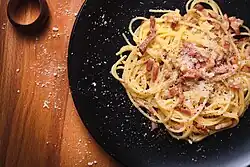
Traditional foods are foods and dishes that are passed on through generations[1] or which have been consumed for many generations.[2] Traditional foods and dishes are traditional in nature, and may have a historic precedent in a national dish, regional cuisine[1] or local cuisine. Traditional foods and beverages may be produced as homemade, by restaurants and small manufacturers, and by large food processing plant facilities.[3]
Some traditional foods have geographical indications and traditional specialties in the European Union designations per European Union schemes of geographical indications and traditional specialties: Protected designation of origin (PDO), Protected geographical indication (PGI) and Traditional specialties guaranteed (TSG). These standards serve to promote and protect names of quality agricultural products and foodstuffs.[4]
This article also includes information about traditional beverages.
Difference between traditional and typical
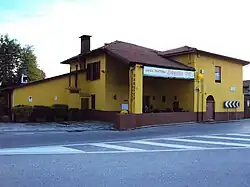
Although it is common for them to be used as synonyms, the truth is that "traditional" cuisine and "typical" cuisine are considered two different concepts according to culinary anthropology; The first refers to culinary customs that are invariably inherited orally, on a small scale in the family, and a large scale in a community as part of its culture and identity. On the other hand, when we speak of typical (or "popular") cuisine, it is one that most people in a place like and is massively replicated.[6] Therefore, a traditional dish may be typical and vice versa, but not all the typical dishes are traditional nor all the traditional ones typical.
Most traditional dishes are originated from the skill of housewives who creatively and sensibly combined the techniques and ingredients they had on hand to create new recipes. If people like that recipe, it becomes worthy of being imitated. In other words, it is spread and replicated so many times that it becomes a classic recipe. For this reason, the culinary tradition is made up of a vast variety of classic recipes, which are necessarily linked to a land of origin, specific products, and specific local habits. There are classic recipes that can fall into oblivion and disappear forever, but if they are consumed massively, they become part of the typical cuisine of a place. The Mexican culinary anthropologist Maru Toledo adds a third concept to this process, which is that of "typical commercial" cuisine,[7] something that did not exist until the commercialization of cuisine (a process that has occurred very recently, if we observe the complete chronology of food history).
Commercialized cuisine
The commercialized cuisine appropriates the characteristics of the traditional (even the same adjective "traditional", on numerous occasions) but the aim is none other than economic profit. For this reason, it does not want to delve into the origin, nor in the context, much less the diversity around the dishes, it sells. Finally, the mainstream population, generally without much culinary knowledge, believe that the food they are buying is their own, thus happening a kind of food acculturation[8] and simplifying the diversity of products, techniques, recipes and other culinary aspects of the tradition.
By continent
Africa
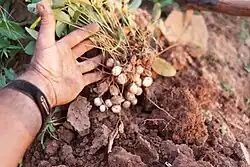
- Bambara groundnut – a traditional food crop in Africa
Europe
Traditional food products have been described as playing "an important part of European culture, identity, and heritage".[9]
South America

- Humita – a traditional food in Bolivia, Chile, Ecuador, and Peru
By country
Canada
- Country food refers to the traditional diets of Aboriginal people (known in Canada as First Nations, Metis, and Inuit), especially in remote northern regions where Western food is an expensive import, and traditional foods are still relied upon.[10][11]
- Thanksgiving dinner
Québec
- Poutine
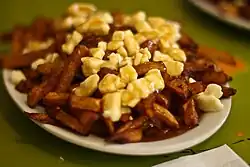
A classic poutine is made with french fries, cheese curds and gravy. - Tourtière
- Sucre à la crème
- Pâté chinois
- Pouding chômeur
- St. Catherine's taffy
- Spruce beer
- Maple syrup
- Cretons
Acadia
- Poutine râpée[12]
- Fricot
China
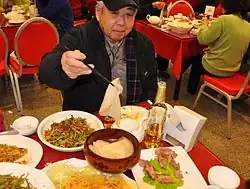
- Ciba cake
- Dim sum
- Fuling jiabing – a traditional snack food of Beijing and an integral part of the city's culture. It is a pancake-like snack made from flour, sugar, and fuling (Poria), rolled around nuts, honey, and other ingredients.
- Spring pancake – a traditional Chinese food unique to the northern regions. People eat spring pancakes on the day called lichun to celebrate the beginning of spring.
- Zhongzi - sticky rice with savory or sweet ingredients wrapped in bamboo leaves and boiled. Made to commemorate the poet and minister Qu Yuan during the Dragon boat festival.
Costa Rica
- Rice and beans[13]
Croatia
- Lecsó
Cyprus
Czech Republic
- Lecsó
- Svíčková
Estonia
- Mulgipuder
- Sepik
Eswatini
Faroe Islands
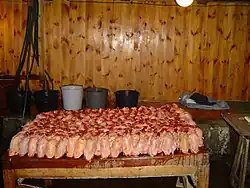
- Faroese puffin
- Garnatálg
- Skerpikjøt
- Whale meat
Finland
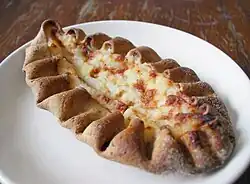
- Karelian stew
- Karelian pasty
- Kesäkeitto
- Sautéed reindeer
- Ruisreikäleipä
- Ryynimakkara
- Mustamakkara
- Kalakukko
- Lörtsy
- Rönttönen
- Sultsina
- Mämmi
- Joulutorttu
France
- Appellation d'origine contrôlée – the French certification granted to certain French geographical indications for wines, cheeses, butters, and other agricultural products
- Bresse chicken – a French chicken product with appellation d'origine contrôlée status
- List of Appellation d'Origine Contrôlée liqueurs and spirits
- List of Appellation d'Origine Contrôlée wines
Germany
- Black Forest ham – produced in the Black Forest region of Germany, it is a Protected Designation of Origin (PDO) food in the European Union.
Guatemala
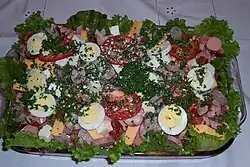
- Fiambre is a traditional Guatemalan dish that is prepared and eaten yearly to celebrate the Day of the Dead (Día de Los Muertos) and the All Saints Day (Día de Todos Los Santos).
Iceland
- Hákarl – a traditional food[16] and national dish of Iceland
- Hangikjöt[17]
- Þorramatur – a selection of traditional Icelandic food,[18] consisting mainly of meat and fish products cured in a traditional manner, cut into slices or pieces and served with rúgbrauð (dense and dark rye bread), butter and brennivín (an Icelandic akvavit)
India
- Kheer
- Roti and Sabzi
South Indian Food
Indonesia
- Brem – a fermented snack and beverage from Java and Bali
- Docang – a traditional food from Cirebon
- Gado-gado – a traditional salad in peanut sauce dressing
- Gudeg – a young unripe jackfruit stew, a traditional food from Yogyakarta
- Ketupat – a traditional rice dumpling commonly served during Lebaran, Indonesian idul fitri
- Kuluban – an ancient Javanese traditional salad
- Lawar – a traditional Balinese vegetable dish
- Opor ayam – chicken in coconut milk stew, a traditional dish commonly consumed with ketupat during Lebaran
- Pallubasa – a traditional food from Makassar, South Sulawesi made from offal of cattle or buffalo
- Papeda – sago congee, a traditional staple of Eastern Indonesia (Maluku and Papua)
- Rendang – traditional Minangkabau dish from West Sumatra
- Satay – grilled meat on skewers, various traditional regional variants exist in Indonesia
- Soto – a category of traditional soup of Indonesia, numerous regional variations exist
- Tempeh – fermented soy cake, traditional food from Java
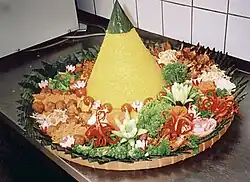
- Tumpeng – a ceremonial rice cone surrounded by various side dishes, an Indonesian national dish
Iran
- Chelow kabab
- Tahdig
- Ghormeh sabzi
- Fesenjān
- Sabzi polo
- Abgoosht
- Gheimeh
- Sholezard
- Āsh
- Mirza Ghassemi
- Nargesi
- Baghala ghatogh
Ireland
- Full breakfast
- Sunday roast[a]
Italy
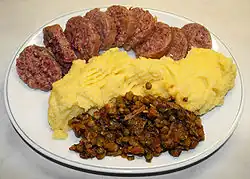
- Abbacchio
- Affogato
- Arancini
- Asiago
- Biscotti
- Braciola
- Bruschetta
- Caciotta
- Cacciucco
- Caponata
- Cappuccino
- Cotechino
- Crostata
- Crostini
- Espresso
- Focaccia
- Frittata
- Frittella
- Fritto misto
- Gelato
- Lasagna
- Mascarpone
- Minestrone
- Mozzarella
- Panettone
- Panna cotta
- Panino
- Panzerotto
- Parmigiano Reggiano
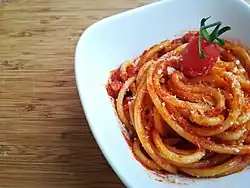
- Pasta
- Pecorino
- Peperonata
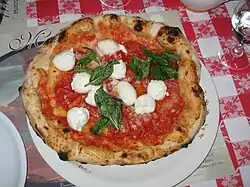
- Pizza
- Polenta
- Porchetta
- Prosciutto
- Ravioli
- Risotto
- Salami
- Salumi
- Scamorza
- Semifreddo
- Spezzatino
- Strudel
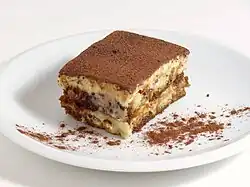
- Tiramisu
- Tortellini
- Zabaione
- Zuppa inglese
By designation of origin

- Denominazione di origine controllata – a quality assurance label for Italian food products, especially Italian wine and cheese
- List of Italian DOC wines
- List of Italian DOCG wines
- Indicazione geografica tipica
- Prodotti agroalimentari tradizionali is an official approval for traditional Italian regional food products similar to the Protected Geographical Status of the European Union.
- Strada dell'Olio – a kind of gastronomical route in Italy that crosses a territory rich of traditional products, PDOs and PGIs, DOCs and DOCGs in Italy.
Japan

- Mochi – eaten year-round in Japan, mochi is a traditional food for the Japanese New Year and is commonly sold and eaten during that time
Jordan
Traditional beverages in Jordan include sous (also referred to as 'irqsus), a drink prepared using the dried root of Glycyrrhiza glabra (liquorice), tamr hindi, a drink prepared from an infusion of the dried pulp of Tamarindus indica (tamarind), and laban (labneh), a drink prepared with yogurt and water.[3] A significant amount of labneh in Jordan and nearby countries continues to be prepared using the traditional method of "straining set yogurt in cloth bags".[3]
Korea

- Bibimbap
- Bulgogi
- Kimchi
- Nurungji
- Sungnyung
Latvia
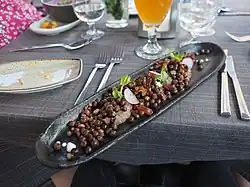
- Grey peas
- Layered rye bread
- Sklandrausis
- Speķrauši
Lithuania
- Cepelinai
Maldives
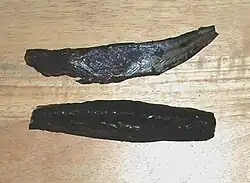
- Garudiya[b]
- Maldives fish – cured tuna fish traditionally produced in the Maldives. It is a staple food in Maldivian cuisine
Malta
- Lent in Malta § Traditional food eaten throughout the period
- Kwareżimal – Lent cake
Mexico
- Atole[21]
- Capirotada – usually eaten during the Lenten period (comida de cuaresma).[22] It is one of the dishes served on Good Friday.
- Chiles[21]
- Enchilada[23]
- Iguana meat
- Legumes, beans and refried beans[21]
- Maize[24]
- Tortilla[25]
- Mole sauce[21]
- Pork[21]
- Rice – traditionally pan fried to a golden color before cooking [21]
- Rice and beans[26]
- Sope[27]
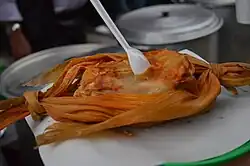
- Tamale[21]
Nepal
- Dhindo
Portugal
- Denominação de Origem Controlada is the system of protected designation of origin for wines, cheeses, butter, and other agricultural products from Portugal.
Saudi Arabia
- Hininy
- Kabsa
Singapore

- Hainanese chicken rice – considered as a national dish of Singapore
- Teochew porridge
Slovakia
- Bryndzové halušky – a national dish of Slovakia consisting of halušky and bryndza.
- Lecsó
South Africa
Spain
- Boroña – a cornbread that is a traditional food in the regions of Galicia, Asturias, Cantabria, the Basque Country and northern Castilla-Leon (areas of León, Palencia and Burgos)
- Denominación de Origen – part of a regulatory classification system primarily for Spanish wines (similar to the French appellations) but also for other foodstuffs like cheeses, condiments, honey and meats, among others
Sweden

- Falukorv
- Janssons frestelse
- Pyttipanna
Switzerland
- Appellation d'origine protégée – A Swiss geographical indication protecting the origin and the quality of traditional food products other than wines
- Capuns – a traditional food from the canton of Graubünden in Switzerland
Tanzania
- Pare people § Traditional food
Thailand
Turkey
- İmam bayıldı[31]
Uganda
- Malewa – smoked bamboo shoot which is dried for preservation. The food originated from Eastern Uganda in the Bugisu sub-region
United Kingdom
England
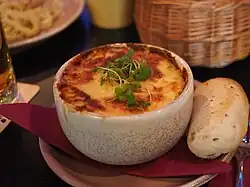
- Bangers and mash
- Cottage pie
- Faggot
- Fish and chips[c]
- Full breakfast
- Sunday roast[d]
Wales
- Cawl
- Welsh cakes
- Glamorgan sausages
- Laverbread
- Welsh rarebit
- Bara brith
Scotland
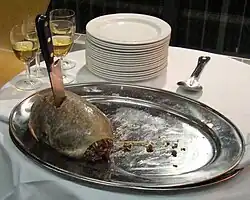
United States
- Cardamom bread – considered as a traditional food among Swedish Americans
- Thanksgiving dinner
Southern United States
Vanuatu
- Laplap – a national dish
Yemen
By region
Arab states of the Persian Gulf
- Khabees – traditional sweet dish in the Arab states of the Persian Gulf
Commonwealth Caribbean
- Rice and peas – a traditional dish in the Anglo-Caribbean
Levant (Eastern Mediterranean)
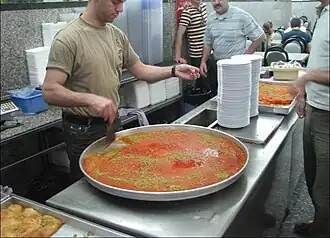
Traditional foods of the Levant include falafel, fuul, halawa, hummus, kanafeh, labaneh, medammis and tahini.[3] among others. The most popular traditional foods in the region are those prepared from legumes, specifically, falafel, fuul, hummus and medammis.[3]
- Popular traditional foods in the Eastern Mediterranean region
-

-
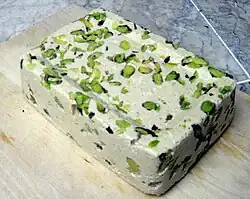
-
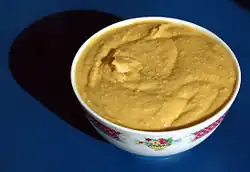
-
-
.jpg)
European Union
- Geographical indications and traditional specialties in the European Union
- Quality Wines Produced in Specified Regions – a quality indicator used within European Union wine regulations that identifies wines with protected geographical indications
- List of geographical designations for spirit drinks in the European Union
Scandinavia
- European crayfish
- Crayfish party
Southern Africa
- Soured milk – traditional food of the Bantu peoples of Southern Africa
See also
- Christmas dinner
- Appellation
- Shrove Tuesday – known in some countries as Pancake Tuesday or Pancake day
- Whole food
Notes
- ^ "... the sizzle of the traditional Sunday roast."[19]
- ^ "Food in the Maldives may be thought of in three categories: the traditional fare, Sri Lanka cuisine, and the newer imported foods. The traditional fare is mostly fish boiled in a broth called Gaudiya, and coconut pieces ..."[20]
- ^ "England's best-known traditional dish is fish and chips ..."[32]
- ^ "... the Sunday roast; the tradition is continued every Sunday lunchtime in pubs and restaurants across England."[33]
References
- ^ a b Kristbergsson, K.; Oliveira, J. (2016). Traditional Foods: General and Consumer Aspects. Integrating Food Science and Engineering Knowledge Into the Food Chain. Springer US. pp. 85–86. ISBN 978-1-4899-7648-2.
- ^ Saunders, Raine (28 October 2010). "What Are Traditional Foods?". Agriculture Society. Retrieved 8 April 2015.
- ^ a b c d e Who Regional Office for the Eastern Mediterranean (2010). Hazard Analysis and Critical Control Point Generic Models for Some Traditional Foods: A Manual for the Eastern Mediterranean Region. World Health Organization. pp. 41–50. ISBN 978-92-9021-590-5.
- ^ "Geographical indications and traditional specialties". europa.eu.
- ^ "Antica trattoria Bagutto" (in Italian). Retrieved 29 November 2020.
{{cite web}}: CS1 maint: deprecated archival service (link) - ^ Midori Hernández, A. (2016). "El fogón de las "Mujeres del Maíz"" (PDF). Cultura Jalisco (in Spanish). 7: 6. Retrieved 29 April 2021.
- ^ Gómez, A. (22 June 2015). "Entrevista a Maru Toledo" (video). YouTube. Archived from the original on 29 April 2021. Retrieved 29 April 2021.
- ^ Guelmami, Z. "L'acculturation à distance Dans Une société de consommation globalisée: le cas de la sous-culture lipophile française" (PDF). Place du Maréchal de Lattre de Tassigny (Paris Dauphine University).
- ^ Guerrero, L.; et al. (1 November 2010). "Consumer-driven definition of traditional food products and innovation in traditional foods. A qualitative cross-cultural study". Appetite. 52 (2): 345–354. doi:10.1016/j.appet.2008.11.008. PMID 19084040. S2CID 17169454.
- ^ Usher, Peter J. Evaluating Country Food in the Northern Native Economy (PDF). pp. 105–120.
- ^ Wein, Eleanor E.; et al. (1990). "Food Consumption Patterns and Use of Country Foods by Native Canadians near Wood Buffalo National Park, Canada". Arctic. 44 (3): 196–206. doi:10.14430/arctic1539.
- ^ Publishing, DK (2014). DK Eyewitness Travel Guide: Canada. Eyewitness Travel Guides. DK Publishing. p. 32. ISBN 978-1-4654-2221-7.
- ^ Long, L.M. (2015). Ethnic American Food Today: A Cultural Encyclopedia. Rowman & Littlefield Publishers. p. 135. ISBN 978-1-4422-2731-6.
- ^ "Products and Recipes". visitcyprus.com. Cyprus Tourism Organisation. Retrieved 26 November 2015.
- ^ "Σφαγή χοίρου & Παρασκευή παραδοσιακών αλλαντικών". foodmuseum.cs.ucy.ac.cy. Cyprus Food Virtual Museum. Retrieved 26 November 2015.
- ^ Helfman, G.; Burgess, G.H. (2014). Sharks. Johns Hopkins University Press. p. 183. ISBN 978-1-4214-1310-5.
- ^ Albala, K. (2011). Food Cultures of the World Encyclopedia [4 volumes]: [Four Volumes]. ABC-CLIO. p. 195. ISBN 978-0-313-37627-6.
- ^ Kalland, A. (2009). Unveiling the Whale: Discourses on Whales and Whaling. Environmental Anthropology and Ethnobiology. Berghahn Books. p. 166. ISBN 978-1-84545-955-0.
- ^ Davenport, F. (2010). Dublin. City Travel Guide Series. Lonely Planet. p. 151. ISBN 978-1-74179-220-1.
- ^ Maloney, Clarence (1980). "Garudiya",+traditional+food People of the Maldive Islands. Orient Longman. ISBN 9780861311583. Retrieved 27 March 2016.
- ^ a b c d e f g h Edelstein, S. (2009). Food, Cuisine, and Cultural Competency for Culinary, Hospitality, and Nutrition Professionals. Jones & Bartlett Learning. pp. 66–73. ISBN 978-0-7637-5965-0.
- ^ Capirotada The Zenchilada page 102 Winter 2011]
- ^ Tatum, C.M. (2013). Encyclopedia of Latino Culture: From Calaveras to Quinceaneras [3 Volumes]: From Calaveras to Quinceañeras. Cultures of the American Mosaic. ABC-CLIO. p. 466. ISBN 978-1-4408-0099-3. Retrieved 27 March 2016.
- ^ Schanbacher, W.D. (2010). The Politics of Food: The Global Conflict Between Food Security and Food Sovereignty. Praeger Security International Series. Praeger Security International. p. 42. ISBN 978-0-313-36328-3.
- ^ Sparks, P.; Swanson, B. (1993). Tortillas!: 75 Quick and Easy Ways to Turn Simple Tortillas Into Healthy Snacks and Mealtime Feasts. St. Martin's Press. p. 3. ISBN 978-0-312-08912-2.
- ^ Adapon, J. (2008). Culinary Art and Anthropology. Bloomsbury Publishing. p. 15. ISBN 978-1-84788-455-8.
- ^ Herbst, R.; Herbst, S.T. (2015). The Deluxe Food Lover's Companion, 2nd edition. Barron's Educational Series. p. pt901. ISBN 978-1-4380-7621-8.
- ^ "Throwback Thursday: Pap and chakalaka". 22 September 2022.
- ^ Dieterle, H.; Friedman, A. (2014). Harold Dieterle's Kitchen Notebook. Grand Central Publishing. p. pt45. ISBN 978-1-4555-2864-6.
- ^ Greenberg, P. (2012). The Best Places for Everything: The Ultimate Insider's Guide to the Greatest Experiences Around the World. Rodale Books. p. 271. ISBN 978-1-60961-829-2.
- ^ Speake, Jennifer; LaFlaur, Mark, eds. (2002). "Imam bayildi". The Oxford Essential Dictionary of Foreign Terms in English. Oxford University Press. ISBN 9780199891573. Retrieved 3 July 2019 – via Oxford Reference.
- ^ Andrews, R. (2011). The Rough Guide to England. Rough Guides. p. 62. ISBN 978-1-4053-8845-0.
- ^ Holland, E. (2012). Pocket Guide to Edwardian England. Createspace Independent Pub. p. pt12. ISBN 978-1-4781-1344-7.
- ^ Gabriel, J. (2014). How to Cook Like a Southerner: Classic Recipes from the South's Best Down-Home Cooks. Thomas Nelson. p. 31. ISBN 978-1-4016-0506-3.
- ^ a b c d "Try traditional Southern foods for New Year's". Bradenton Herald. 31 December 2008. Retrieved 27 March 2016.
Further reading
- Ferrando, R. (1981). Traditional and Non-traditional Foods. FAO food and nutrition series. Food and Agriculture Organization of the United Nations. pp. 1–156. ISBN 978-92-5-100167-7. PMID 7343324.
- Yanagida, F.; Kenkyūjo, Tōkyō Nōgyō Daigaku. Sōgō (1987). Traditional foods and their processing in Asia. NODAI Research Institute, Tokyo University of Agriculture.
- Zaigui, L.; Hongzhuo, T. (2009). Traditional Chinese Foods: Production and Research Progress. Food science and technology series. Nova Science Publishers. ISBN 978-1-60692-902-5.
- Ray, R.C.; Didier, M. (2014). Microorganisms and Fermentation of Traditional Foods. Food Biology Series. Taylor & Francis. ISBN 978-1-4822-2308-8.
Cuisines | |||||||||||||
|---|---|---|---|---|---|---|---|---|---|---|---|---|---|
| Continental |
| ||||||||||||
| National and (regional) |
| ||||||||||||
| Ethnic |
| ||||||||||||
| Religious | |||||||||||||
| Historical |
| ||||||||||||
| Styles | |||||||||||||
| Lists |
| ||||||||||||
| Related | |||||||||||||
| |||||||||||||


Lists of prepared foods | |||||||||||||||||||||
|---|---|---|---|---|---|---|---|---|---|---|---|---|---|---|---|---|---|---|---|---|---|
| Dishes by origin |
| ||||||||||||||||||||
| By type and origin |
| ||||||||||||||||||||
| By type |
| ||||||||||||||||||||
| |||||||||||||||||||||
