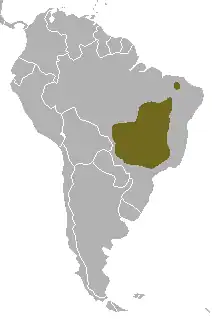
The hoary fox or hoary zorro (Lycalopex vetulus), also known as raposinha-do-campo in Brazil (Portuguese for "little fox of the meadow"), is a species of zorro or "false" fox endemic to Brazil. Unlike many other foxes, it feeds primarily on small invertebrates such as insects.
Description
The hoary fox has a short muzzle, small teeth, a short coat, and slender limbs. The upper part of the body is grey, and the underside of the body is cream or fawn. The tail is black on the tip with a marked dark stripe along the upper surface, which in male animals may extend all the way along the back to the nape of the neck. The ears and outside part of the legs are reddish or tawny, and the lower jaw is black. Some melanistic individuals have also been reported.[3][4]
It is small for a fox, weighing only 3 to 4 kg (6.6 to 8.8 lb), with a head and body length of 58 to 72 cm (23 to 28 in), and a tail 25 to 36 cm (9.8 to 14.2 in). Together with its slender form, the small size of the hoary fox makes it an agile and fast-running animal, while its relatively weak teeth adapt it to feeding on invertebrates, rather than larger prey.[4]
Behaviour and diet
Hoary foxes are nocturnal,[5] and largely solitary outside of the breeding season. They mainly eat insects, especially termites, dung beetles, and grasshoppers,[6] but also may eat rodents, small birds, and fruit. Individuals have widely varying home ranges, depending on the local environment and reported examples are as follows: 385 ha (950 acres) for 1 adult female in southern Bahia, 456 ha (1,130 acres) for a group consisting of an adult breeding pair and 5 juvenile offspring in a pasture of Minas Gerais, and 48 ha (120 acres) for 2 breeding pairs out of 3 study groups from pastures in eastern Mato Grosso.[4]
Range
The hoary fox is endemic to Brazil and its geographic distribution is associated with the limits of the Cerrado ecosystem, in an altitude range of 90–1,100 m.[4] However, it can also be found in transition zones, including open habitats in the Pantanal. The occurrence of the hoary fox in areas of the Atlantic Forest is in a matrix of anthropogenic pastures, regionally interspersed by remnants of semideciduous forest and small patches of Cerrado.[7]
The current extension extends from the northeast and west of São Paulo to the north of Piauí, passing through the states of Ceará, Mato Grosso do Sul, Mato Grosso, Goiás, Distrito Federal, Minas Gerais, Tocantins, Bahia and probably open regions in the south of the states of Rondônia.
Reproduction
Females usually give birth to two to four pups in August to September, after a gestation period around 50 days.[4] The sex ratio of the pups is equal between males and females.[5] The female prepares a den in which to give birth, sometimes using the burrows of other animals. Weaning occurs around 4 months of age.[4] Both parents participate in rearing of the pups.[5]
References
- ^ Wozencraft, W. C. (2005). "Order Carnivora". In Wilson, D. E.; Reeder, D. M. (eds.). Mammal Species of the World: A Taxonomic and Geographic Reference (3rd ed.). Johns Hopkins University Press. ISBN 978-0-8018-8221-0. OCLC 62265494.
- ^ Lemos, F.G.; Azevedo, F.C.; Paula, R.C.; Dalponte, J.C. (2020). "Lycalopex vetulus". IUCN Red List of Threatened Species. 2020 e.T6926A87695615. doi:10.2305/IUCN.UK.2020-2.RLTS.T6926A87695615.en. Retrieved 19 November 2021.
- ^ "Lycalopex vetulus". University of Michigan Museum of Zoology. Animal Diversity Web. Retrieved 30 October 2010.
- ^ a b c d e f
Julio C., Dalponte (2009). "Lycalopex vetulus (Carnivora: Canidae)". Mammalian Species. 847: 1–7. doi:10.1644/847.1.
- ^ a b c Courtenay, O.; et al. (2006). "First observations on South America's largely insectivorous canid: the hoary fox (Pseudalopex vetulus)". Journal of Zoology. 268 (1): 45–54. doi:10.1111/j.1469-7998.2005.00021.x.
- ^ "Lycalopex vetulus (Hoary fox)". Animal Diversity Web.
- ^ Dalponte, J. C.; Oliveira, J. S.; Lacerda, A. C. R. (2018). "Occurrence of Lycalopex vetulus (Carnivora, Canidae) in the Cerrado-Amazon forest ecotone and Pantanal". Acta Zoológica Platense. 18: 1–10. Retrieved 19 July 2021.
|
|---|
|
Feliformia ("cat-like" carnivorans) |
|---|
Feliformia |
- African palm civet (Nandinia binotata)
| Feloidea | | Prionodon (Asiatic linsangs) |
- Banded linsang (P. linsang)
- Spotted linsang (P. pardicolor)
|
|---|
| | Felinae sensu stricto | Bay cat
lineage | |
|---|
Caracal
lineage | |
|---|
| Leopardus | |
|---|
| Lynx | |
|---|
Puma
lineage | |
|---|
Leopard cat
lineage | |
|---|
| Felis | |
|---|
|
|---|
|
|---|
|
|
|---|
| | Viverroidea | |
|---|
|
|---|
|
|
Viverroidea |
|---|
Viverridae | Palm civets | | Hemigalinae |
- Owston's palm civet (Chrotogale owstoni)
- Otter civet (Cynogale bennettii)
- Hose's palm civet (Diplogale hosei)
- Banded palm civet (Hemigalus derbyanus)
|
|---|
| Paradoxurinae |
- Binturong (Arctictis binturong)
- Small-toothed palm civet (Arctogalidia trivirgata)
- Sulawesi palm civet (Macrogalidia musschenbroekii)
- Masked palm civet (Paguma larvata)
| | Paradoxurus | |
|---|
|
|---|
|
|---|
Viverrinae sensu lato | Viverrinae
sensu stricto |
- Small Indian civet (Viverricula indica)
- African civet (Civettictis civetta)
| | Viverra |
- Malabar large-spotted civet (V. civettina)
- Large-spotted civet (V. megaspila)
- Malayan civet (V. tangalunga)
- Large Indian civet (V. zibetha)
|
|---|
|
|---|
| Genettinae | Poiana
(African linsangs) |
- Central African oyan (P. richardsonii)
- West African oyan (P. leightoni)
|
|---|
Genetta
(genets) |
- Abyssinian genet (G. abyssinica)
- Angolan genet (G. angolensis)
- Bourlon's genet (G. bourloni)
- Crested servaline genet (G. cristata)
- South African small-spotted genet (G. felina)
- Common genet (G. genetta)
- Johnston's genet (G. johnstoni)
- Letaba genet (G. letabae)
- Rusty-spotted genet (G. maculata)
- Pardine genet (G. pardina)
- Aquatic genet (G. piscivora)
- King genet (G. poensis)
- Schouteden's genet (G. schoutedeni)
- Servaline genet (G. servalina)
- Hausa genet (G. thierryi)
- Cape genet (G. tigrina)
- Giant forest genet (G. victoriae)
|
|---|
|
|---|
|
|---|
|
|
|---|
|
|
|
Herpestoidea |
|---|
| | Eupleridae
(Malagasy
carnivorans) | Euplerinae
(Malagasy civets) | | | Eupleres (falanoucs) |
- Eastern falanouc (E. goudotii)
- Western falanouc (E. major)
|
|---|
|
|---|
Galidiinae
(vontsira) |
- Ring-tailed vontsira (Galidia elegans)
| | Galidictis |
- Broad-striped Malagasy mongoose (G. fasciata)
- Grandidier's mongoose (G. grandidieri)
|
|---|
- Narrow-striped mongoose (Mungotictis decemlineata)
| | Salanoia | |
|---|
|
|---|
|
|---|
| | | | Suricata | |
|---|
- Liberian mongoose (Liberiictus kuhni)
| | Mungos |
- Gambian mongoose (M. gambianus)
- Banded mongoose (M. mungo)
|
|---|
- Pousargues's mongoose (Dologale dybowskii)
| | Helogale |
- Ethiopian dwarf mongoose (H. hirtula)
- Common dwarf mongoose (H. parvula)
|
|---|
Crossarchus
(kusimanses) |
- Alexander's kusimanse (C. alexandri)
- Angolan kusimanse (C. ansorgei)
- Common kusimanse (C. obscurus)
- Flat-headed kusimanse (C. platycephalus)
|
|---|
|
|---|
|
- Marsh mongoose (Atilax paludinosus)
- Long-nosed mongoose (Xenogale naso)
| Urva
(Asian mongooses) |
- Small Indian mongoose (U. auropunctata)
- Short-tailed mongoose (U. brachyura)
- Indian grey mongoose (U. edwardsii)
- Indian brown mongoose (U. fusca)
- Javan mongoose (U. javanica)
- Collared mongoose (U. semitorquata)
- Ruddy mongoose (U. smithii)
- Crab-eating mongoose (U. urva)
- Stripe-necked mongoose (U. vitticolla)
|
|---|
- White-tailed mongoose (Ichneumia albicauda)
- Yellow mongoose (Cynictis penicillata)
- Selous's mongoose (Paracynictis selousi)
- Meller's mongoose (Rhynchogale melleri)
| | Bdeogale |
- Bushy-tailed mongoose (B. crassicauda)
- Jackson's mongoose (B. jacksoni)
- Black-footed mongoose (B. nigripes)
|
|---|
Herpestes
(slender mongooses) |
- Angolan slender mongoose (H. flavescens)
- Egyptian mongoose (H. ichneumon)
- Somalian slender mongoose (H. ochracea)
- Cape gray mongoose (H. pulverulenta)
- Common slender mongoose (H. sanguinea)
|
|---|
|
|---|
|
|---|
|
|---|
|
|
|
|---|
| | Vulpini | | Nyctereutes
(raccoon dogs) | |
|---|
Vulpes
(true foxes) | |
|---|
|
|---|
Canini (true dogs) |
Cerdocyonina
(zorro)
| | | Speothos | |
|---|
- Short-eared dog (Atelocynus microtis)
- Crab-eating fox (Cerdocyon thous)
|
| Lycalopex
(South American foxes) | |
|---|
|
|---|
Canina
(wolf-like canids)
| |
|---|
|
|---|
|
|---|
Arctoidea | | | Ailuropoda | |
|---|
| Tremarctos | |
|---|
| Ursinae | |
|---|
|
|---|
|
|
|---|
|
|
|
|---|
| Otariidae (eared seals) | Callorhinus
(northern fur seals) |
- Northern fur seal (C. ursinus)
|
|---|
Otariinae
(sea lions) | |
|---|
| | Neophoca |
- Australian sea lion (N. cinerea)
|
|---|
- New Zealand sea lion (Phocarctos hookeri)
| Arctocephalus
(southern fur seals) |
- South American fur seal (A. australis)
- Australasian fur seal (A. forsteri)
- Galápagos fur seal (A. galapagoensis)
- Antarctic fur seal (A. gazella)
- Juan Fernández fur seal (A. philippii)
- Brown fur seal (A. pusillus)
- Guadalupe fur seal (A. townsendi)
- Subantarctic fur seal (A. tropicalis)
|
|---|
|
|---|
|
Phocinae
("northern seals")
|
- Bearded seal (Erignathus barbatus)
- Hooded seal (Cystophora cristata)
| Phocini | |
|---|
|
|---|
Monachinae
("southern seals")
| |
|---|
|
|---|
|
|
Musteloidea |
|---|
| Mephitidae (skunks) | Conepatus
(hog-nosed skunks) |
- Molina's hog-nosed skunk (C. chinga)
- Humboldt's hog-nosed skunk (C. humboldtii)
- American hog-nosed skunk (C. leuconotus)
- Striped hog-nosed skunk (C. semistriatus)
|
|---|
| Mephitis | |
|---|
Mydaus
(stink badgers) |
- Sunda stink badger (M. javanensis)
- Palawan stink badger (M. marchei)
|
|---|
Spilogale
(spotted skunks) |
- Southern spotted skunk (S. angustifrons)
- Western spotted skunk (S. gracilis)
- Eastern spotted skunk (S. putorius)
- Pygmy spotted skunk (S. pygmaea)
|
|---|
|
|---|
Procyonidae | | | Bassariscus |
- Ringtail (B. astutus)
- Cacomistle (B. sumichrasti)
|
|---|
Procyon
(raccoons) | |
|---|
Bassaricyon
(olingos) |
- Eastern lowland olingo (B. alleni)
- Northern olingo (B. gabbii)
- Western lowland olingo (B. medius)
- Olinguito (B. neblina)
|
|---|
Nasuina
(coatis) | | Nasua | |
|---|
Nasuella
(mountain coatis) |
- Eastern mountain coati (N. meridensis)
- Western mountain coati (N. olivacea)
|
|---|
|
|---|
|
|---|
|
|
|
Mustelidae |
|---|
Mustelidae | | | Mellivora | |
|---|
| Arctonyx
(hog badgers) |
- Northern hog badger (A. albogularis)
- Greater hog badger (A. collaris)
- Sumatran hog badger (A. hoevenii)
|
|---|
Meles
(Eurasian badgers) | |
|---|
|
|---|
| Melogale
(ferret-badgers) |
- Vietnam ferret-badger (M. cucphuongensis)
- Bornean ferret badger (M. everetti)
- Chinese ferret-badger (M. moschata)
- Javan ferret-badger (M. orientalis)
- Burmese ferret-badger (M. personata)
- Formosan ferret-badger (M. subaurantiaca)
|
|---|
Guloninae | |
|---|
Ictonychinae | | Lyncodontini |
- Patagonian weasel (Lyncodon patagonicus)
| Galictis
(grisons) |
- Lesser grison (G. cuja)
- Greater grison (G. vittata)
|
|---|
|
|---|
Ictonychini
(African polecats) | | Vormela |
- Marbled polecat (V. peregusna)
|
|---|
- African striped weasel (Poecilogale albinucha)
| | Ictonyx |
- Saharan striped polecat (I. libycus)
- Striped polecat (I. striatus)
|
|---|
|
|---|
|
|---|
| | | Lontra | |
|---|
| Enhydra | |
|---|
- Spotted-necked otter (Hydrictis maculicollis)
| | Lutra | |
|---|
| Lutrogale |
- Smooth-coated otter (L. perspicillata)
|
|---|
| Aonyx |
- African clawless otter (A. capensis)
- Asian small-clawed otter (A. cinereus)
- Congo clawless otter (A. congicus)
|
|---|
|
|---|
Mustelinae | Neogale
(New World weasels) | |
|---|
| | subgenus Mustela
(paraphyletic) | |
|---|
subgenus Lutreola
(paraphyletic) |
- Japanese weasel (M. itatsi)
- European mink (M. lutreola)
- Indonesian mountain weasel (M. lutreolina)
- Malayan weasel (M. nudipes)
- Siberian weasel (M. sibirica)
- Back-striped weasel (M. strigidorsa)
|
|---|
| subgenus Putorius | |
|---|
|
|---|
|
|---|
|
|
|---|
|
|
|
Taxon identifiers |
|---|
| Lycalopex vetulus | |
|---|
| Canis vetulus | |
|---|